Login
Reset your password
We will send you an email to reset your password.


If you’ve ever opened a bag of coffee that smells flat or lifeless, you know how disappointing that first brew can be. Freshness isn’t just about the roast date, it’s about how well your coffee is protected once it leaves the roaster.
Light and oxygen accelerate aroma oxidation in foods, reducing flavor quality. Research from the National Center for Biotechnology Information explains that even small amounts of oxygen can trigger oxidative rancidity and destroy volatile flavor compounds, one of the main reasons sealed, oxygen-proof packaging is critical for preserving coffee freshness.
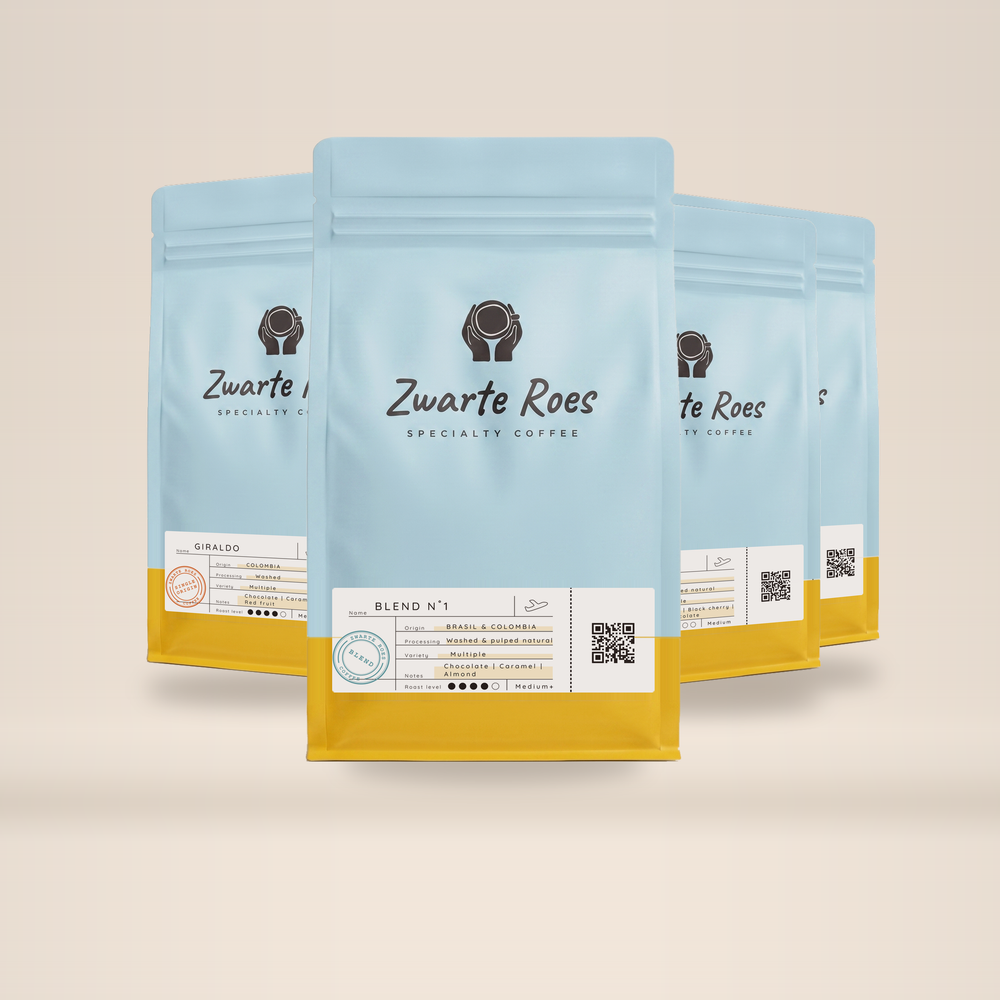
At Zwarte Roes, we obsessed over every millimeter of our packaging to make sure your coffee arrives as vibrant as the day it was roasted.
TL;DR
Our packaging isn’t just a bag, it’s a mini vault. Every detail is engineered for coffee packaging freshness: oxygen-blocking layers, a one-way degassing valve, a tight resealable zip, and full light protection, all working to keep your coffee at its flavor peak as long as possible.
Coffee is alive, at least, freshly roasted coffee is.
After roasting, beans continue to release CO₂ and dozens of aromatic compounds. Those volatile compounds are the essence of flavor: caramel sweetness, fruit acidity, nutty undertones, and delicate florals.
The tragedy is, they’re also fragile. Air, light, and moisture tear them apart faster than most people realize.
That’s why packaging isn’t an afterthought for us, it’s part of the roasting process. You can roast perfectly and still end up with dull coffee if your packaging can’t hold the line.
We learned that early on, when one of our first test batches lost its brightness within two weeks because of thin material and no valve. It was a good reminder: the bag can make or break the bean.
You’ve probably noticed that small circular valve on the front of our bags. It looks simple but it’s one of the most important components.
Freshly roasted coffee gives off gas for days, and if you trap that gas, the bag can puff up like a balloon or worse, burst. The one-way valve lets CO₂ escape while locking out oxygen. This balance prevents staleness and keeps the internal environment stable.
It also gives you a small sensory bonus: when you squeeze the bag gently, you can actually smell the coffee through the valve. That aroma isn’t leaking freshness, it's venting harmless CO₂ while keeping oxygen out.
We also remind customers that freshness doesn’t stop at the bag: grinding accelerates staling fast, so grind right before brewing. If you want a simple benchmark for aroma fade and flavor drop-off, how long coffee stays fresh and what affects it gives you the cues to watch for in both smell and taste.
When we started designing our packaging, we tested over a dozen different materials. The problem? Most “eco” materials didn’t perform well in real-world storage. Some looked nice on a shelf but leaked aroma after a few days. Others warped or softened with humidity.
We finally landed on a multi-layer high-barrier film, a combination of polymer layers that completely block oxygen and moisture. The inner layer keeps oils from seeping out, the middle layer acts as a gas barrier, and the outer layer gives the bag its strength and matte texture.
Some roasters prioritize the paper aesthetic. We get it, it feels artisanal.
But we’d rather your coffee tastes artisanal than just look at it. So we made sure our film is not only functional but recyclable through dedicated programs. In other words, freshness first, sustainability right behind it.
Our tests showed that beans stored in this packaging retained around 90% of their aromatics even after four weeks, compared to less than 60% in unprotected paper bags. That’s the kind of measurable difference that justifies the obsession.
Light is one of coffee’s silent killers.
UV radiation speeds up oxidation, especially in light-roasted beans where the oils are still inside the bean’s surface. Transparent packaging might look modern, but under bright shop lights, it’s like slow-roasting your coffee all over again.
Our matte, opaque finish blocks harmful light completely. It also feels good in your hands, smooth but firm, with just enough grip. The subdued tone was intentional too. It reflects our brand philosophy: substance over spectacle.
If you keep your coffee bag in a bright kitchen or near a window, that light protection matters. It’s one more layer between you and a stale cup.
Once you open a bag, oxygen becomes your main enemy. Even the tiniest gap in a seal can let in enough air to dull the flavor within days. Our resealable zip closure helps you fight that battle. It’s thick, double-lined, and designed for easy closing even with one hand.
We tested this with baristas who open their coffee dozens of times a day. The verdict: it works. The bag seals tight, holds its shape, and doesn’t shed coffee dust into the groove.
Still, there’s a limit to what any seal can do. For long-term freshness, squeeze out the air before closing or store the bag in an airtight container; storing freshly roasted coffee beans in a vacuum canister or well-sealed jar slows oxidation noticeably.
We didn’t want fancy packaging that wins design awards but frustrates people in the morning rush. So, we tested every prototype in real kitchens.
We asked customers: does it open easily? Can you pour without spilling beans everywhere? Does it stand upright? Does it still look good after two weeks of daily handling?
Those insights shaped the final product. The wide base prevents tipping. The tear-notch opens cleanly without scissors. And the minimal branding leaves space for what matters most: the roast date and origin information. No clutter, no distractions.
Our design language mirrors our roasting philosophy, clarity, precision, and honesty. What you see is what you brew.
Even the best packaging can’t cheat time. Coffee has a natural life cycle, and part of our responsibility as roasters is to respect it. That’s why we roast to order and ship within days. No months-old stock sitting in a warehouse.
We also print the exact roast date on every bag, not a generic “best before.” You should always know when your coffee was roasted, because flavor evolves quickly in those first few weeks. Stored correctly, our beans stay at their sweet spot for six to eight weeks after roasting, long enough to enjoy, short enough to stay vibrant.
There’s another angle to freshness that people rarely talk about: waste. Stale coffee is wasted coffee. If packaging can extend freshness by a few weeks, that means fewer discarded beans and less environmental impact.
We chose materials that can be processed through recycling systems and suppliers who follow strict European environmental standards. It’s not perfect, no packaging is, but it’s a balance between performance, sustainability, and the reality of how people store and drink coffee.
The result: a bag that protects the planet a little more by protecting your coffee a lot better.
Freshness isn’t a marketing claim, it’s a form of respect. Every bag represents months of labor by farmers, processors, importers, and roasters. If that effort gets lost to poor packaging, it’s not just a waste of flavor, it’s a waste of craft.
That’s why our packaging is part of our identity. It’s quiet, functional, and built to last through the full journey, from our roastery to your grinder. When you open it and catch that wave of aroma, you’re not just smelling fresh coffee. You’re smelling the result of every deliberate choice we made along the way.